
A single tiny spark in a control panel or an undetected gas leak can halt an entire factory's operations in Batam for months, or worse, cause catastrophic losses that are impossible to quantify. In the midst of rapid growth in the oil and gas, shipbuilding, and chemical manufacturing sectors in the Riau Islands, compliance with international safety standards is no longer just an administrative choice—it is the foundation of business continuity. Statistics indicate that approximately 10% to 15% of major industrial accidents in high-risk zones are caused by the failure of electrical equipment that does not meet explosion protection standards.
What is ATEX Certification and Why Does Batam Industry Need It?
ATEX (Atmosphères Explosibles) certification is the mandatory standard in the European Union—now globally adopted, including by multinational corporations in Batam—for equipment used in environments with potentially explosive atmospheres. The standard comprises two main directives: ATEX 114 (regarding equipment manufacturers) and ATEX 153 (regarding worker safety in the workplace). For operational managers in Batam's industrial zones, understanding ATEX means ensuring that every component, from motors to sensors, is designed so it does not become an ignition source in areas containing flammable gases, vapors, or dust.
Why is this particularly relevant for industries in the Riau Islands? Our region is a hub for heavy industry. According to data from the Batam Indonesia Free Zone Authority (BP Batam), the manufacturing and oil and gas support sectors remain the backbone of the local economy. Working environments in shipyards or oil refineries have a high risk of explosive atmospheres. Using equipment without proper certification not only endangers lives but also risks voiding insurance claims if an incident occurs. This is why our Electrical Engineering services always prioritize compliance with these international standards.
Classification of Hazardous Zones According to ATEX Standards
Understanding ATEX certification begins with area mapping, often referred to as Area Classification. Not every area in your factory requires equipment with the highest level of protection, but misclassification can be fatal. International standards divide these zones into two main categories: Gases/Vapors/Mists and Dust.
Gas, Vapor, and Mist Zones (Zone 0, 1, and 2)
1. Zone 0: An area where an explosive atmosphere is present continuously or for long periods (e.g., inside a fuel tank). Equipment here must have a very high level of protection (Category 1).
2. Zone 1: An area where an explosive atmosphere is likely to occur in normal operation (e.g., chemical filling areas). Requires Category 2 equipment.
3. Zone 2: An area where an explosive atmosphere is not likely to occur in normal operation and, if it does, will persist for a short period only. Requires Category 3 equipment.
Combustible Dust Zones (Zone 20, 21, and 22)
Often overlooked in electronics manufacturing or wood processing industries in Batam, fine dust can be a powerful explosive. Zone 20, 21, and 22 classifications follow the same principles as gas zones but focus on the presence of flammable dust clouds. In implementing Industrial Automation solutions, PT Wahari Nawa Manunggal ensures that sensors and actuators installed in these zones have the appropriate IP (Ingress Protection) ratings and ATEX certification for the dust load on site.
How to Read ATEX Codes on Electrical Equipment
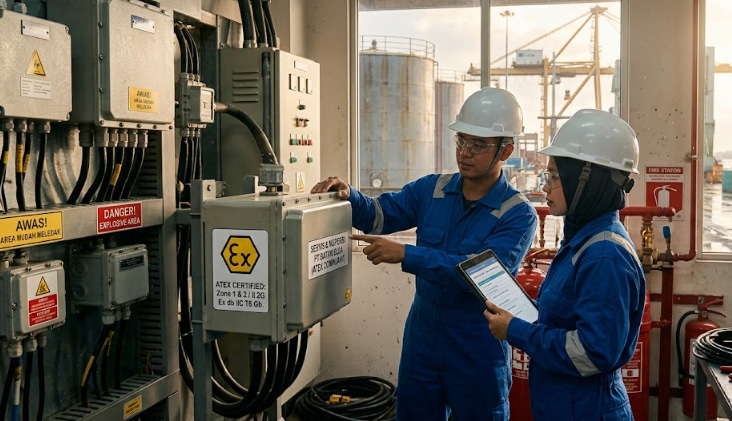
Have you ever noticed the nameplate on an industrial motor or explosion-proof light in your factory? Understanding these codes is a crucial skill for procurement managers in Batam. An ATEX-certified piece of equipment will feature the "Ex" mark inside a hexagon, followed by a series of technical symbols. For example, the code II 2 G Ex d IIC T6 Gb provides very specific information about the device's capabilities.
- II: Indicates equipment for surface industries (not underground mines).
- 2 G: Indicates the equipment is safe for Zone 1 (Gas).
- Ex d: Indicates the "Flameproof enclosure" protection method, where any internal explosion is contained by the casing so it does not spread outside.
- IIC: The most dangerous gas group (such as Hydrogen).
- T6: Temperature classification. T6 means the maximum surface temperature of the device will not exceed 85°C—crucial for preventing the ignition of gases with low flash points.
Real-world scenarios in Batam often involve using equipment in environments with high salinity (salt content). As a trusted Parts & General Supplier, we always advise clients to pay attention to the equipment's casing material, in addition to just its ATEX certification, to prevent corrosion that could compromise the integrity of the explosion protection.
Implementing SCADA and Control Panels in Hazardous Zones
Integrating technology within hazardous zones doesn't stop at selecting motors or lights. Complex control systems such as SCADA (Supervisory Control and Data Acquisition) and PLCs (Programmable Logic Controllers) must also be designed with intrinsic safety in mind. In Batam's industrial zones, many factories are moving toward full automation to increase operational efficiency.
However, the challenge lies in how to connect sensors in Zone 0 or Zone 1 to a safe control room. This is where Intrinsic Safety Barriers or Zener Barriers become vital. These components limit the electrical energy (current and voltage) entering the hazardous zone, ensuring there isn't enough energy to produce a spark that could trigger an explosion. In every Robotics & Software integration project, PT Wahari Nawa Manunggal ensures that data communication lines between field machines and servers remain secure and meet IEC 61511 standards for functional safety.
Frequently Asked Questions
ATEX is a legal standard applicable in the European Union (EU Directive), while IECEx is a voluntary international standard under the International Electrotechnical Commission. Many companies in Batam accept both, but for global operations, IECEx is often preferred as it facilitates cross-border certification without the need for extensive re-testing.
No. Only equipment installed or used within areas classified as "Hazardous Zones" (Zones 0, 1, 2 or 20, 21, 22) must have ATEX certification or other explosion protection standards. Conducting an area classification audit is a crucial first step to avoid wasting costs on unnecessary specialized equipment.
Compliance does not end at purchase. ATEX equipment requires periodic inspection by competent technicians according to IEC 60079-17 standards. In Batam's corrosive environment, checking seal integrity, casing bolts, and corrosion on electrical terminals is essential to ensure protection features continue to function at their best.
Conclusion
Electrical safety in hazardous zones is about more than just meeting regulations; it's about protecting your greatest assets: your employees and your operational continuity. Understanding ATEX certification provides peace of mind for business owners in Batam's industrial areas, knowing that their investments are shielded from the risk of explosive disasters. With accurate zone classification, the right component selection, and installation that meets international standards, you not only comply with the law but also enhance your company's competitive advantage in the global market.
Are you certain that the electrical installations and automation systems in your factory are fully safe from explosion risks? Don't let safety gaps threaten your business. Consult for free with our team at PT Wahari Nawa Manunggal for system audits or procurement of internationally certified components. As a Batam-based partner about PT Wahari Nawa Manunggal, we are ready to help you implement the best technical solutions prioritizing safety and efficiency.