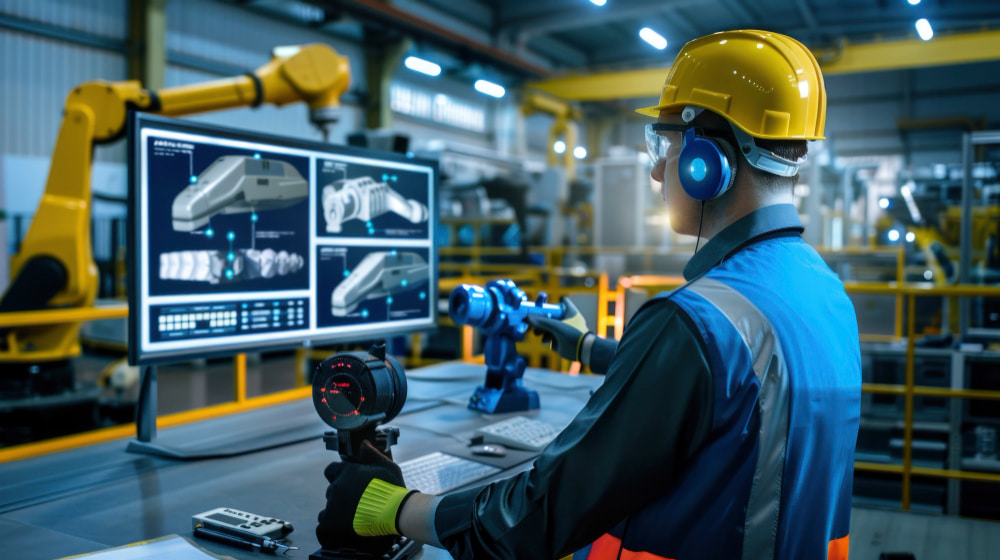

A production error rate of 2% might sound insignificant on paper, but for a manufacturer in Batam's industrial zones producing 1 million electronic components per month, that translates to 20,000 defective units. These defects can tarnish brand reputation and skyrocket operational costs. Amid global pressure to achieve zero-defect levels, human eyes are no longer sufficient to keep pace with modern production lines operating in milliseconds. This is why Machine Vision Systems have become the front line in the Quality Control Automation revolution for global manufacturing, including strategic hubs like Riau Islands.
Machine Vision Systems are more than just cameras taking pictures; they represent the intelligent integration of optical hardware, image sensors, and data processing algorithms capable of making instantaneous logical decisions. For operational managers and IT heads in Batam, this technology offers a solution to a classic challenge: how to maintain 100% inspection accuracy at maximum production line speeds? By enabling automated anomaly detection, precision dimensional measurement, and ID code reading, these systems transform passive production lines into responsive, intelligent ecosystems.
Why Machine Vision-Based Quality Control Automation is Urgent for Batam Industries
Batam's industrial landscape, from Muka Kuning to Kabil, is dominated by high-precision sectors such as Electronics Manufacturing Services (EMS), medical device manufacturing, and automotive components. According to reports from McKinsey & Company, implementing AI and machine vision in manufacturing can increase productivity by up to 40% and reduce maintenance costs by 10-20%. These figures aren't just theoretical statistics; they are competitive realities that local companies must embrace to remain relevant in export markets.
On the ground, we often encounter challenges where manual inspection leads to human fatigue, resulting in defective products reaching the consumer. With the right Industrial Automation solution, this risk can be entirely eliminated. Machine Vision Systems work tirelessly with the same level of consistency in the first hour as in the twelfth hour of a shift. These systems can detect microscopic scratches on PCBs, verify component completeness in complex assemblies, and ensure labels are applied with perfect symmetry according to international standards like ISO 9001.
However, efficiency isn't the only advantage. Data generated from every visual inspection process can be collected and analyzed to identify failure patterns in production machinery. If the system detects an increasing defect trend at the same coordinate point, maintenance teams can intervene before a fatal breakdown occurs. This is what we call proactive quality management—a standard now widely adopted by smart factories in Batam to cut material scrap and rework costs.
Technical Components and Architecture of Modern Machine Vision Systems
Understanding Machine Vision Systems requires a deep dive into how hardware and software synergize. These systems typically consist of several critical components that must be specifically configured based on production floor requirements. Here are the key elements in an industrial vision system architecture:
- Lighting: The foundation of any vision system. Lighting techniques such as backlighting, ring lighting, or low-angle darkfield are used to highlight features of the product to be inspected while minimizing unwanted reflections.
- Lenses and Camera Sensors: Industrial cameras differ from consumer cameras. They use CCD or CMOS sensors with global shutters to capture images of fast-moving objects without blur distortion.
- Processor/Vision Controller: Where the algorithms are executed. This is where the software performs feature extraction, pattern matching, and 'Pass/Fail' decision-making.
- Industrial Communication: Inspection results are sent to a PLC (Programmable Logic Controller) via protocols like Modbus, Profinet, or EtherNet/IP to trigger physical actions, such as activating a rejector arm.
At PT Wahari Nawa Manunggal, we ensure that Robotics & Software integration within these vision systems runs in harmony with existing infrastructure. For instance, integrating with SCARA robots to sort products based on quality grades in real-time. By utilizing technical standards like IEC 61131 for control programming, we guarantee high-reliability systems for Batam's harsh 24/7 industrial environments.
It is important to note that selecting specific light wavelengths (e.g., using UV or Infrared) can unlock inspection capabilities invisible to the human eye. In Batam's pharmaceutical industry, for example, Machine Vision is used to verify bottle seal integrity through opaque plastic wrapping—a task impossible to perform manually without damaging the packaging. This flexibility makes Quality Control Automation a highly profitable long-term investment.
Integrating Machine Vision with Digital and ERP Ecosystems
One common mistake companies make when adopting technology is letting systems operate in silos. Effective Machine Vision Systems should be connected to the broader enterprise management system. Data from every inspected item can be sent directly to a central database for auditing and traceability purposes.
Imagine if every quality inspection data point were integrated directly with our ERP Customization services based on Odoo. Management could view real-time production quality reports from the head office, even if the factory is located at a different site across Riau Islands. This enables total transparency over raw material vendor performance; if a specific batch of material frequently yields defects, you have concrete data for renegotiation or supplier replacement.
Furthermore, this integration supports the digital twin concept, where a digital representation of the production process is continuously updated by vision sensor inputs. By leveraging Electrical Engineering services to ensure power stability and data communication between control panels, Machine Vision Systems become the eyes for your company's digital brain. This is the true role of industrial technology: not just replacing human tasks, but expanding the organization's capacity to learn and evolve from the data they generate.
Real-World Scenario: Efficiency on SMT (Surface Mount Technology) Lines
In Batam's electronics industry, placing components as small as grains of sand on PCB boards is a daily standard. A placement error of just 0.1mm can cause the entire device to malfunction. Machine Vision Systems perform Automated Optical Inspection (AOI) to verify component orientation, solder paste presence, and solder joint quality. With processing speeds of thousands of components per minute, these systems provide quality assurance that no manual QC team, regardless of size, could ever achieve.
Challenges and Implementation Strategies in Batam Industrial Zones
While the benefits are immense, implementing Machine Vision Systems is not without challenges. Environmental factors such as machine vibration, industrial dust, and fluctuating ambient lighting can affect sensor accuracy. Additionally, the limited availability of local talent skilled in advanced vision programming often becomes a hurdle for Batam companies attempting self-maintenance.
The strategy we apply at PT Wahari Nawa Manunggal is providing end-to-end solutions that include feasibility studies, optical design, installation, and operator training. We believe technology should serve humans, not the other way around. Therefore, the Human-Machine Interfaces (HMI) we build are designed to be intuitive, allowing factory QC staff to adjust inspection parameters without writing complex lines of code.
Data from the International Federation of Robotics shows that the density of robots and automation systems in Southeast Asia is increasing by 15% annually. For business owners in Batam, delaying the adoption of Machine Vision means handing a competitive advantage to regional competitors. With the support of a reliable Parts & General Supplier to ensure local availability of cameras and sensors, concerns about prolonged downtime can be significantly minimized.
Frequently Asked Questions
Implementation costs vary widely depending on inspection complexity, line speed, and required accuracy. Initial investment may range from tens to hundreds of millions of IDR. However, ROI (Return on Investment) is typically achieved within 6-18 months through labor savings, scrap reduction, and avoiding defective product claims. We recommend starting with a pilot project on a single critical production line.
Yes, with advancements in Deep Learning and AI, machine vision can now handle organic or irregular shapes, such as in the food or garment industries. Unlike traditional rule-based algorithms, AI is trained using thousands of image examples to recognize 'good' vs. 'defective' products, making it highly flexible for various product variations without massive reprogramming.
As a Batam-based company, PT Wahari Nawa Manunggal provides rapid on-site technical support. We understand that every minute of downtime in industrial zones is valuable. Our support includes periodic calibration, software updates, and in-depth training for your internal maintenance team to ensure the system consistently operates at peak performance.
Conclusion
Machine Vision Systems are no longer a technology of the future; they are an urgent necessity for Batam manufacturers who wish to remain competitive on the global stage. By automating Quality Control, companies not only improve accuracy and speed but also build a robust data foundation for their Industry 4.0 transformation. This transition may feel challenging, but with the right technology partner, the journey toward zero-defect production is an investment that yields definitive results in operational efficiency and higher customer trust.
Ready to elevate your production quality standards and minimize human error? Don't let your business fall behind in Batam's increasingly tight industrial competition. Our expert team at PT Wahari Nawa Manunggal is ready to help you design a Machine Vision solution tailored to your factory's unique challenges. From technical consultation to seamless system integration, we are your local partner in Batam. Contact us today for a free consultation with our team and discover how Quality Control Automation can revolutionize your production line.