
Tearing Down the Steel Cages: Redefining the Factory Floor
Picture a typical factory floor in the industrial hubs of Cikarang or Karawang. Traditionally, you would see massive industrial robots encased in sturdy steel safety cages, moving at lethal speeds, and completely isolated from human workers. However, that landscape is undergoing a radical transformation. Those fences are starting to come down, not for aesthetic reasons, but because of a technological breakthrough known as Collaborative Robots, or Cobots.
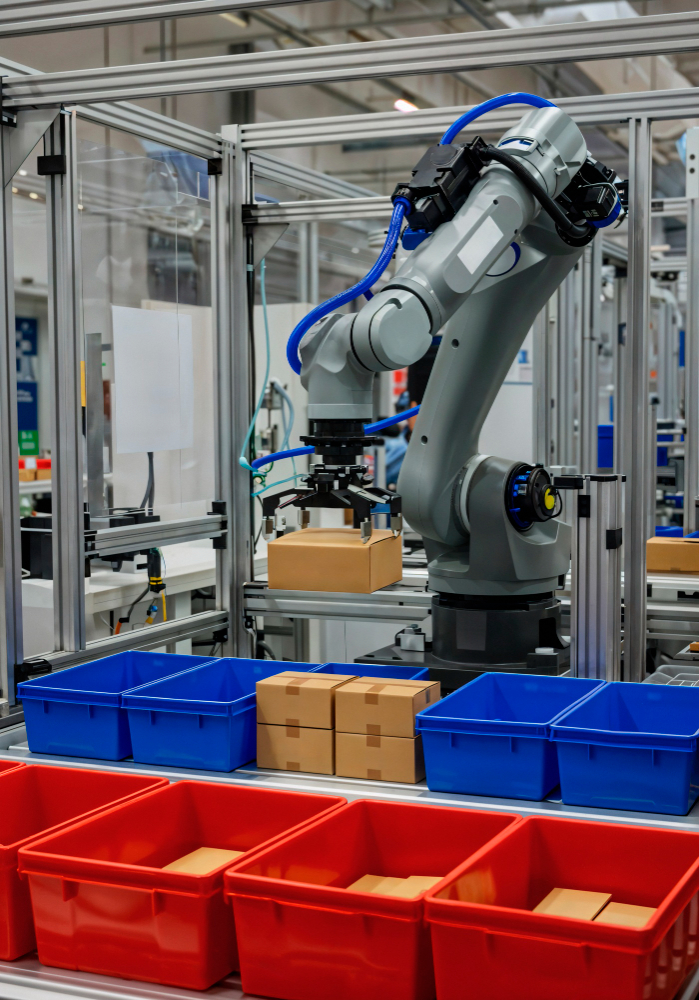
What exactly sets a cobot apart? Unlike its rigid predecessors, a cobot is designed with advanced sensors and force-limiting capabilities that allow it to work alongside human operators without the risk of serious injury. If a worker touches a cobot’s arm, the machine stops instantly. The question is no longer about whether robots will replace humans, but rather how effectively humans and robots can work together as a synchronized team.
According to reports from the International Federation of Robotics (IFR), the collaborative robot market is projected to grow at a CAGR of 20% to 30% over the next few years. In Indonesia, this momentum is bolstered by the government’s Making Indonesia 4.0 initiative. Companies no longer view automation as a daunting capital expenditure, but as a strategic investment to sharpen their edge in an increasingly competitive global market.
Safety Without Compromise and Operational Flexibility
Safety has long been the primary barrier to traditional robotics adoption. The cost of installing safety fences, light curtains, and interlocking systems often accounts for up to 30% of the total integration cost. Cobots slash these costs significantly. With integrated safety features like Power and Force Limiting (PFL), cobots are inherently safe for human interaction.
However, the real selling point for cobots in Indonesian factories isn't just safety—it's flexibility. Today’s manufacturing industry faces the challenge of shorter product lifecycles and the demand for mass customization. Traditional robots, bolted to the floor and programmed for one specific task, are no longer sufficient. In contrast, cobots are lightweight and remarkably easy to reprogram.
For instance, in the electronics assembly industry, a cobot can be programmed to perform pick-and-place tasks in the morning, then moved to another line for screw driving or packaging in the afternoon. This agility allows Indonesian Small and Medium Enterprises (SMEs) to adopt automation without overhauling their entire factory layout. Industry data suggests that cobot implementation can boost line productivity by up to 50% simply by eliminating the idle time between manual processes.
The Mathematics of Automation: Calculating Realistic ROI
Many business leaders in Indonesia are still trapped in the myth that robotics is reserved only for giant corporations with bottomless budgets. Evidence on the ground suggests otherwise. Cobots offer a Return on Investment (ROI) that is significantly faster than conventional industrial robots. Why is this the case?
- Low Integration Costs: Without the need for extensive safety guarding and complex programming, initial costs can be reduced by up to 40%.
- Energy Consumption: Cobots typically operate on standard household electrical power, making them much more efficient than heavy robotic systems that require specialized power infrastructure.
- Speed of Deployment: A cobot can often be installed and operational within days, rather than weeks or months.
Let’s look at a real-world scenario. A mid-sized automotive component factory in West Java adopted cobots for quality inspection. Previously, this task was handled by two operators across two shifts with high fatigue levels, leading to a 3% error margin. After integrating cobots with vision systems, the error rate dropped to less than 0.1%, and the two operators were successfully redeployed to more complex quality oversight roles. In this scenario, ROI is typically achieved within 12 to 18 months—a figure that is highly attractive to any CFO.
Preparing the Workforce for the Collaborative Era
The fear of unemployment due to robotics is an old narrative that is losing its grip. In Indonesia, the primary challenge is actually the skills gap. Cobots aren't here to take jobs; they are here to take over the 3D tasks: Dull, Dirty, and Dangerous.
By delegating repetitive tasks to machines, human workers can be upskilled into roles such as robot operators or production data analysts. This creates a more humane and ergonomic work environment. Is it fair to let a worker lift heavy loads for 8 hours a day if a robotic arm can do it without fatigue? Certainly not. This transformation also demands that companies invest in the reskilling of their employees.
The integration of software such as ERP and inventory management systems with a cobot fleet provides real-time data transparency. This is where the true power of modern industry lies: when data from the shop floor flows seamlessly to the management desk, enabling decision-making based on facts, not just intuition.
Is your business still struggling with stagnant production efficiency or finding it hard to secure skilled labor for high-risk repetitive tasks? Many manufacturing firms in Indonesia face these exact hurdles while trying to navigate the shift to Industry 4.0 — and that is precisely why PT Wahari Nawa Manunggal is here. With deep expertise in Electrical Engineering and Industrial Automation, we don’t just sell technology; we engineer solutions tailored to your specific scale and needs. Let’s start the conversation on transforming your production floor today at https://waharinawa.com